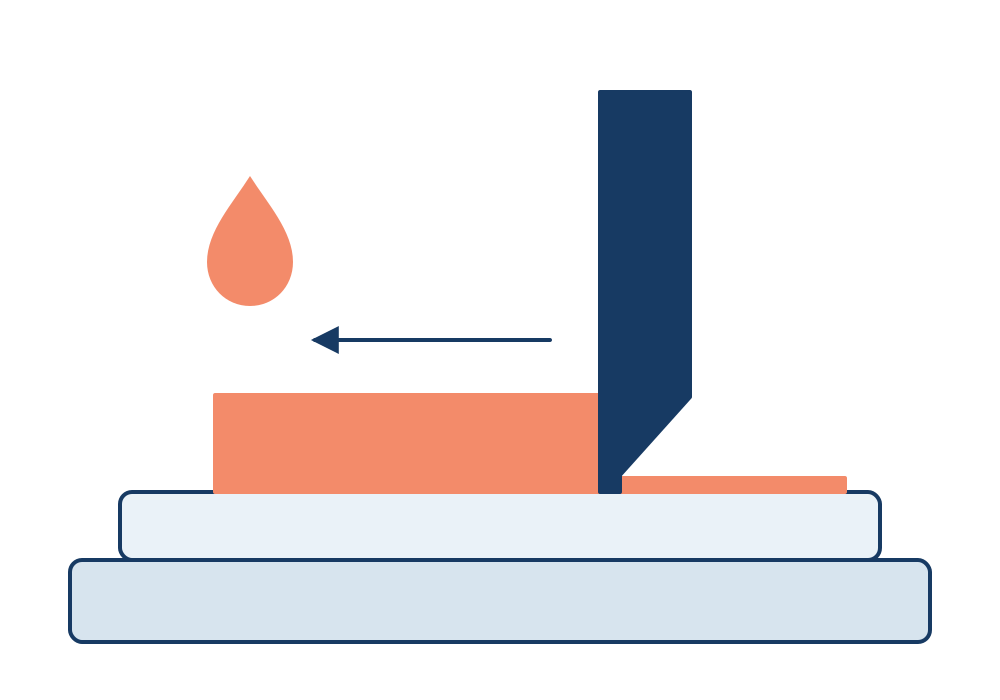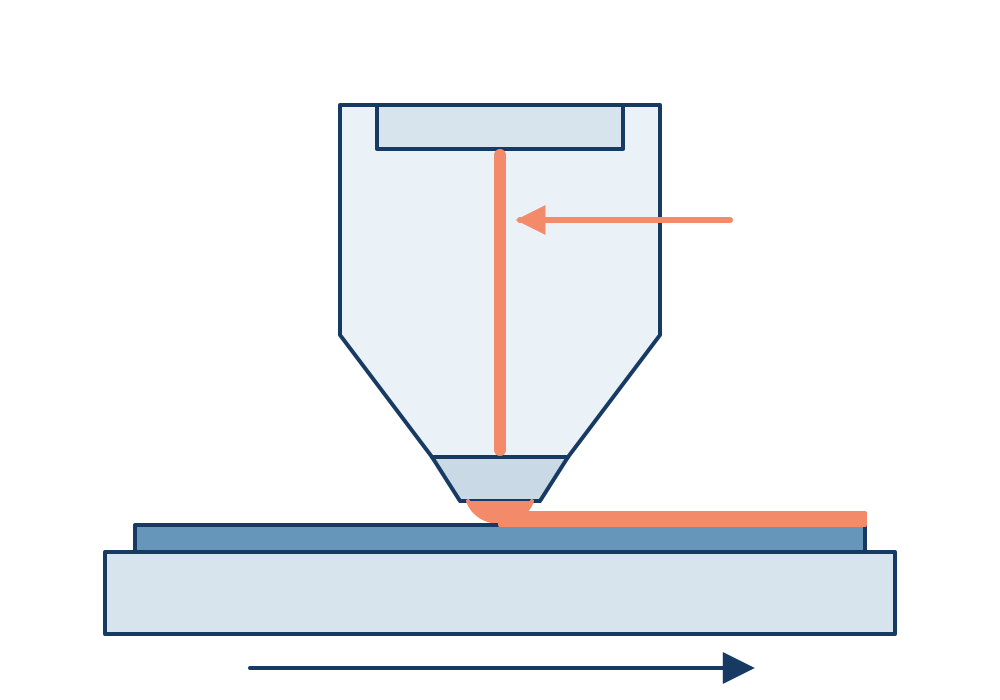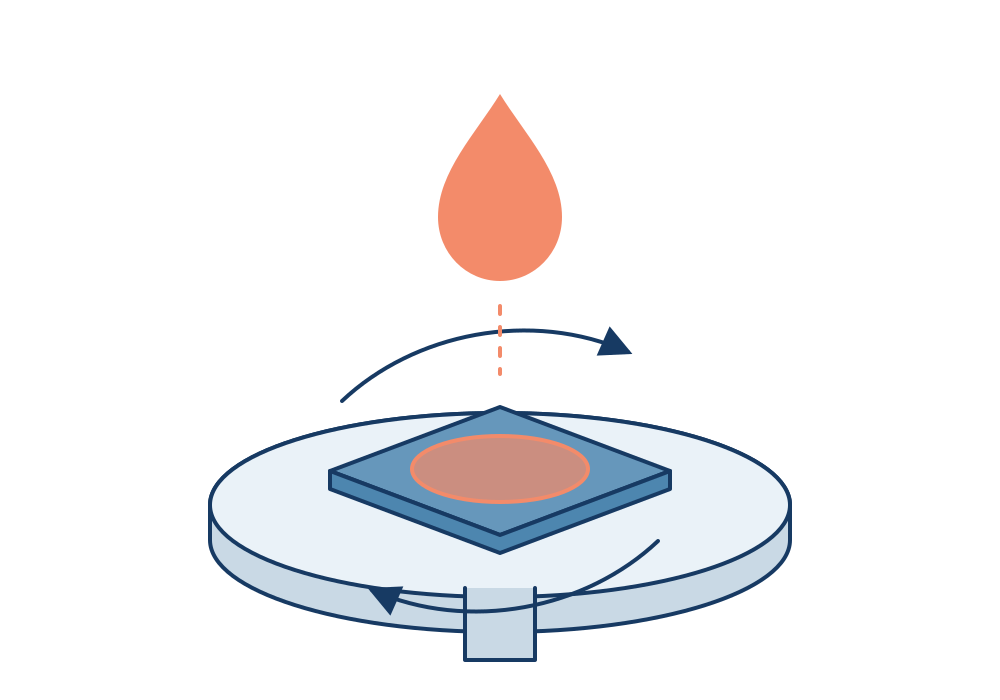
Laboratory screening
Spin Coating
Fast, reproducible film formation for small, flat substrates.
- Small-area samples
- Low equipment complexity
- High material loss
MRKC · Knowledge Collection
Thin films form the functional basis of technologies ranging from solar cells and batteries to sensors, displays and optical coatings. This collection explains how solution-based deposition methods create functional layers—and how wetting, thickness control, drying and process stability determine the final result.
Creating a functional thin film involves more than depositing liquid onto a substrate. The formulation must first be prepared for reliable coating, then deposited as a controlled wet layer and dried under conditions that produce the required structure. Each stage influences the next—and together they determine the uniformity and performance of the finished film.
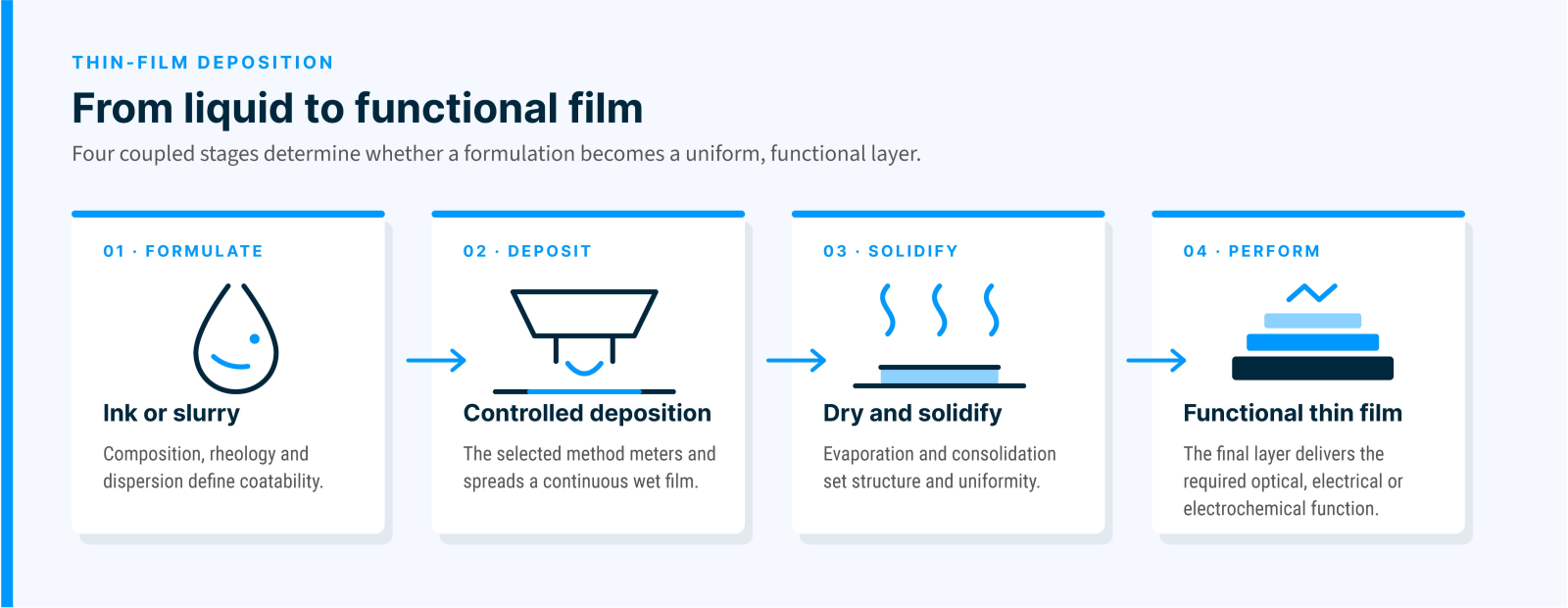
The core challenge: from liquid to solid film
Nearly every solution-based deposition method faces the same underlying physical challenge: how do you take a liquid formulation and convert it into a solid, uniform, defect-free film with a precisely controlled thickness? This challenge can be broken down into a few interlocking sub-problems that recur across every technique covered in this collection:
Wetting and coverage. The liquid ink or solution must spread evenly across the substrate surface. If the ink doesn't wet the surface properly, it will bead up, dewet, or leave gaps, resulting in pinholes or incomplete coverage. Surface energy, substrate cleanliness, and ink formulation (solvents, additives, surfactants) all play a role here.
Thickness control. Device performance is often extremely sensitive to film thickness. A perovskite absorber layer that's too thin won't absorb enough light; one that's too thick introduces excessive series resistance and recombination losses. Each deposition method controls thickness through a different physical mechanism — rotation speed in spin coating, gap height in blade coating, flow rate in slot-die coating, and so on.
Solvent removal and drying kinetics. Once the wet film is deposited, the solvent must evaporate (or be actively removed) to leave behind the solid functional material. The speed and uniformity of this drying step has an outsized effect on the final film's microstructure — how it nucleates, crystallizes, and forms grains. Fast, uncontrolled drying often produces rough, defect-rich films, while engineered post-deposition treatments can dramatically improve film quality. Three such treatments recur across the field: antisolvent quenching, which drips a non-solvent onto the wet film to trigger rapid, controlled supersaturation and nucleation; gas quenching, which blows a stream of gas across the film immediately after coating to accelerate and even out solvent evaporation; and thermal annealing, which uses controlled heating after (or during) deposition to drive off residual solvent, promote crystallization, and relieve film stress. These treatments are not deposition methods in themselves — they are applied after the wet film has been laid down — but they are often just as decisive as the coating technique itself in determining the final film's microstructure and performance.
Uniformity and reproducibility. For a technique to be useful — whether in a research lab screening hundreds of formulations or a factory producing millions of devices — it needs to produce films that are consistent from batch to batch and uniform across the whole substrate area. This is where many lab-scale methods (spin coating, in particular) start to show their limitations when the goal shifts from proof-of-concept to manufacturing.
The main families of solution-based deposition
While the articles in this collection cover each technique individually in depth, it's useful to see the landscape at a glance:
Thin-film deposition
Each technique controls the wet film differently. Compare their operating principle, laboratory role and potential for scale-up.
Laboratory screening
Fast, reproducible film formation for small, flat substrates.
Process development
Gap-controlled coating for material-efficient laboratory development.
Scalable processing
Pre-metered coating for uniform films and continuous production.
Compare the options
No single technique is best for every material or development stage. Use this comparison as a starting point, then consider ink properties, substrate geometry, film requirements and the intended scale of production.
| Method | Best suited to | Material use | Patterning | Continuous scale-up |
|---|---|---|---|---|
| Spin coating | Small, flat substrates and rapid laboratory screening | |||
| Doctor blading | Sheet coating and laboratory process development | |||
| Slot-die coating | Uniform stripes, large areas and moving webs | |||
| Spray coating | Large, textured or non-flat substrates | |||
| Inkjet printing | Selective digital patterns and formulation screening |
Ratings are qualitative. Actual suitability depends on the formulation, substrate, required film quality and equipment configuration.
Need help selecting a method?
Explore the complete deposition-method decision guide.
Several practical factors typically drive this decision:
--Substrate size and shape: Small, rigid, flat substrates favor spin coating; large or flexible/roll-based substrates favor slot-die, spray, or blade coating.
--Material utilization: Spin coating is highly wasteful; slot-die and inkjet are highly efficient, which matters enormously for expensive or scarce materials.
--Throughput and scalability: Slot-die coating and spray coating are the most naturally compatible with continuous, high-throughput roll-to-roll manufacturing.
--Patterning requirements: Only inkjet printing offers native digital patterning without a separate masking or etching step.
--Film quality requirements: Applications with very tight thickness and uniformity tolerances (e.g., high-efficiency photovoltaics) may still favor spin coating or slot-die coating over spray coating, which tends to produce a rougher, more textured surface.
--Cost and equipment complexity: Doctor blading and spin coating require comparatively simple, inexpensive equipment; slot-die and inkjet systems require more sophisticated (and costly) hardware and process control.
Research applications
Deposition and drying conditions shape more than film thickness. They influence the structure, uniformity and performance of the final device or electrode.
Solar-energy research
Coating and drying determine coverage, crystallisation, grain structure and the interfaces that govern photovoltaic performance.
Electrode production
Slurry formulation, electrode coating and drying control mass loading, adhesion, porosity and reproducibility before cells are assembled.
Perovskite solar cells have become one of the most closely watched technologies in renewable energy because of their remarkable rise in power conversion efficiency over roughly the last fifteen years, rivaling and in some architectures surpassing traditional silicon. Much of that progress has been enabled — and constrained — by deposition science. Perovskite films crystallize directly during the coating and drying process, meaning the deposition method doesn't just apply the material, it actively determines the resulting crystal structure, grain size, and defect density of the finished film. Techniques like anti-solvent dripping (commonly used with spin coating) helped establish record efficiencies in lab-scale devices, but translating those results to large-area, commercially relevant modules has driven intense research into scalable alternatives such as slot-die coating, blade coating, and spray coating — each of which requires reengineering the crystallization process that anti-solvent spin coating had relied on.
Battery electrode manufacturing, meanwhile, represents solution-based deposition at true industrial scale. Lithium-ion battery electrodes are produced by coating a slurry — a mixture of active material, conductive additive, and binder suspended in a solvent — onto thin metal foil (copper for anodes, aluminum for cathodes) using slot-die or blade coating on continuous roll-to-roll lines running at meters per second. Here, the challenges shift from single-substrate reproducibility toward long-run process stability, drying uniformity across meters of coated web, and minimizing defects across kilometers of continuously produced material, since even small, rare defects can compound into significant yield losses or safety issues at scale.
The articles gathered under this overview are designed to take you from foundational concepts through to practical, application-specific guidance:
1. Spin Coating Explained, Doctor Blading Explained, Slot-Die Coating, Spray Coating, and Inkjet Printing each provide a deep, technique-specific treatment: how the method physically works, what governs film thickness and uniformity, typical equipment, and common failure modes.
2. Spin Coating vs Doctor Blading offers a direct, practical comparison between the two most common lab-scale methods, useful when deciding how to move a formulation from initial screening toward more scalable processing.
3. Choosing the Right Deposition Method synthesizes the decision criteria introduced above into a structured framework for selecting a technique based on your material, substrate, and production goals.
4. Thin-Film Deposition for Perovskites and Thin-Film Deposition for Batteries apply everything covered in the earlier articles to two of the most demanding and commercially important application domains, where deposition science directly determines device performance and manufacturability.
Together, these articles form a practical, technically grounded introduction to a field that sits at the intersection of chemistry, materials science, and process engineering — one where getting a few micrometers of material exactly right can make the difference between a laboratory curiosity and a commercially viable product.
---